
Hydrochloric Acid Systems
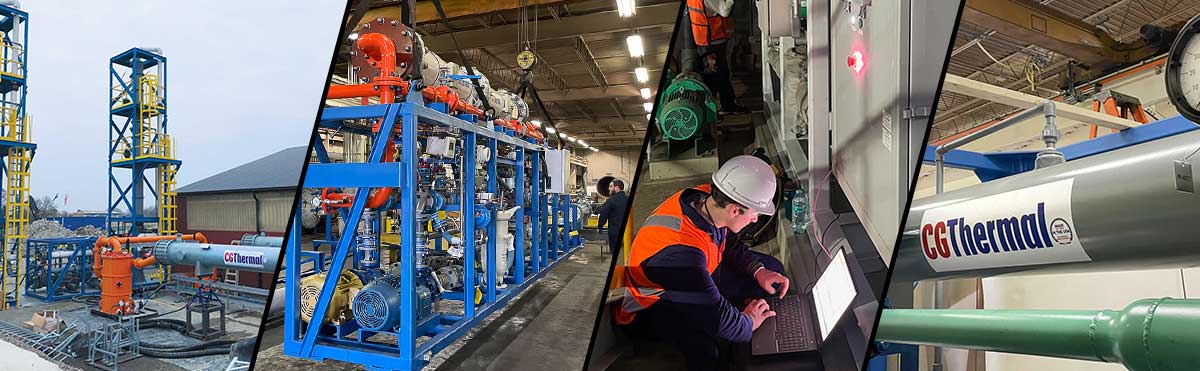
CG Thermal designs hydrochloric acid systems for HCl recovery, absorption, desorption, purification, and other demanding process applications. Our team combines practical HCl process experience with heat and mass transfer expertise and corrosion-resistant equipment design.
Different industries can face similar HCl recovery challenges. We apply established process knowledge to each application’s stream composition, operating conditions, and required product—whether supplying individual equipment or developing an integrated process system.

Practical HCl Process and Design Expertise
An effective HCl system requires an understanding of both the process chemistry and the equipment that handles it. Feed composition, product requirements, heat removal, material compatibility, and process control all influence the design.
CG Thermal has over 40 years of experience working with HCl. Our experience with HCl recovery applications helps us recognize where established approaches can transfer between industries and where a process requires a different configuration. We work with customers to define the required outcome and develop the equipment and system around it.
Our process design tools and equipment designs have been applied in operating HCl systems, including chemical manufacturing and steel processing applications where acid is used as a feedstock or recovered as a byproduct.
Safety and reliability guide system design, including controllable operating conditions and materials selected for compatibility, availability, and service life.
HCl Absorption Systems
HCl absorption systems capture hydrogen chloride gas in water or a weak hydrochloric acid stream. Depending on the application, the objective may be to recover acid for reuse, produce a specified acid concentration, or treat a process gas stream.
Heat management is central to absorber design. CG Thermal evaluates the incoming gas, absorption liquid, cooling utilities, and required acid strength to select an appropriate approach.
Isothermal Absorption Systems
Isothermal absorption systems remove heat during absorption, commonly using a water-cooled falling film absorber. Controlling temperature helps support the production of higher-strength hydrochloric acid.
Depending on the design, gas and liquid can flow co-currently or countercurrently. In a co-current falling film absorber, both streams enter at the top and leave at the bottom. A downstream scrubber captures residual HCl with fresh water; the resulting weak acid can feed the falling film absorber.
The absorber, scrubber, and cooling equipment are selected together to meet recovery and product requirements. Applications include vinyl chloride monomer (VCM), TDI, MDI, silicones, and fumed silica production, where managing the heat released during absorption is a key design consideration.
Adiabatic Absorption Systems
Adiabatic absorption systems use an absorption column in which HCl-containing gas typically enters at the bottom and absorption liquid enters at the top. The countercurrent flow brings the gas and liquid into contact. Heat released during absorption raises the process temperature and can evaporate water.
This approach may suit lower-concentration HCl gas streams containing other constituents, including solvents or inerts that require venting. Depending on the process, a graphite condenser removes water vapor from the leaving gas, while a separate graphite heat exchanger cools the acid product.
Applications include ethylene dichloride (EDC) processing, electronic waste incineration, and chlorinated organics processing. Gas composition, cooling requirements, and the required acid concentration determine whether an adiabatic approach is appropriate.
White Paper: Design Parameters for HCl Absorption Systems
Explore how thermodynamics, heat management, and mechanical design influence HCl absorption performance. Our white paper covers thermodynamic modeling, falling film absorber design, liquid distribution, and other considerations affecting reliability.

HCl Process Systems
HCl Desorption Systems
Desorption separates hydrogen chloride from aqueous hydrochloric acid by heating the acid in a corrosion-resistant column. The system can be combined with appropriate separation, drying, and purification stages to produce anhydrous hydrogen chloride (AHCl) for downstream use.
Feed composition, acid concentration, contaminants, moisture, inert gases, and the required gas purity determine the overall system configuration.
HCl Azeotrope Breaking Systems
HCl and water form a maximum-boiling azeotrope: a composition at which the boiling liquid and vapor have the same composition. This limits separation by conventional distillation. Extractive rectification and dual-pressure technology provide approaches to overcoming this separation limit.
Applications include producing AHCl from weak or concentrated hydrochloric acid and recovering HCl for reuse in VCM and high-purity silicone processes. HCl separation can also support downstream chlorine recovery through catalytic oxidation in the Deacon process, including in TDI production. Feed composition, operating pressures, and the required product determine technology selection.
HCl Scrubbing Systems
Scrubbing systems remove residual HCl from process gases. Design must account for changing gas conditions, liquid handling, and specified outlet requirements. Process simulation helps evaluate performance against the application’s emissions and permitting requirements.
HCl Synthesis Systems
HCl synthesis involves the strongly exothermic reaction of hydrogen and chlorine to produce hydrogen chloride. Depending on the required product, gas handling and absorption equipment can be integrated to supply anhydrous hydrogen chloride or aqueous hydrochloric acid.
Proper burner design and management, process control, and equipment for handling the reaction products are central to safe, reliable operation.
AHCl Purification and Liquefaction
Purification and liquefaction systems condition recovered hydrogen chloride for use as a gas or liquid product. Applications include byproduct HCl recovery associated with VCM and fumed silica production, as well as high-purity HCl requirements in chemical processing.
Equipment must be selected around the required product quality, operating pressure, temperature, and handling requirements. Liquid HCl handling also requires consideration of thermal expansion and pressure protection wherever liquid may become trapped.
Drying HCl Gas Streams
Drying reduces moisture in HCl gas streams to meet downstream product purity and material requirements. Moisture control also influences corrosion behavior and the materials of construction available for downstream equipment.
Depending on the application, drying arrangements may use columns, heat exchangers, or molecular sieve adsorbents such as zeolites. Selection depends on the incoming composition and required moisture level, with temperature control important to adsorption performance and corrosion management.
HCl System Design in Practice
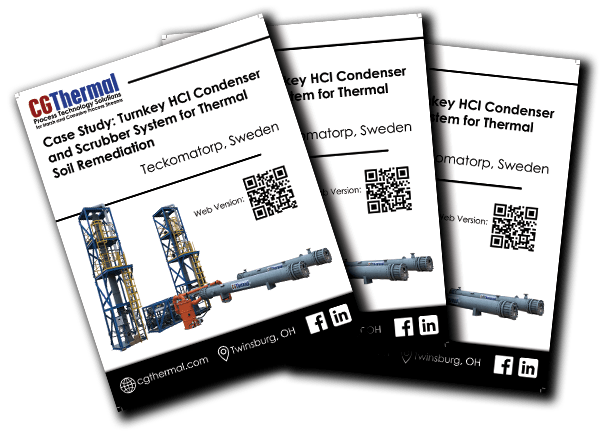
Practical system experience brings process calculations, equipment selection, fabrication, and controls together. Our thermal soil remediation project in Sweden demonstrates how CG Thermal can develop a broader solution from an initial equipment request.
Turnkey HCl Condenser and Scrubber System for Thermal Soil Remediation
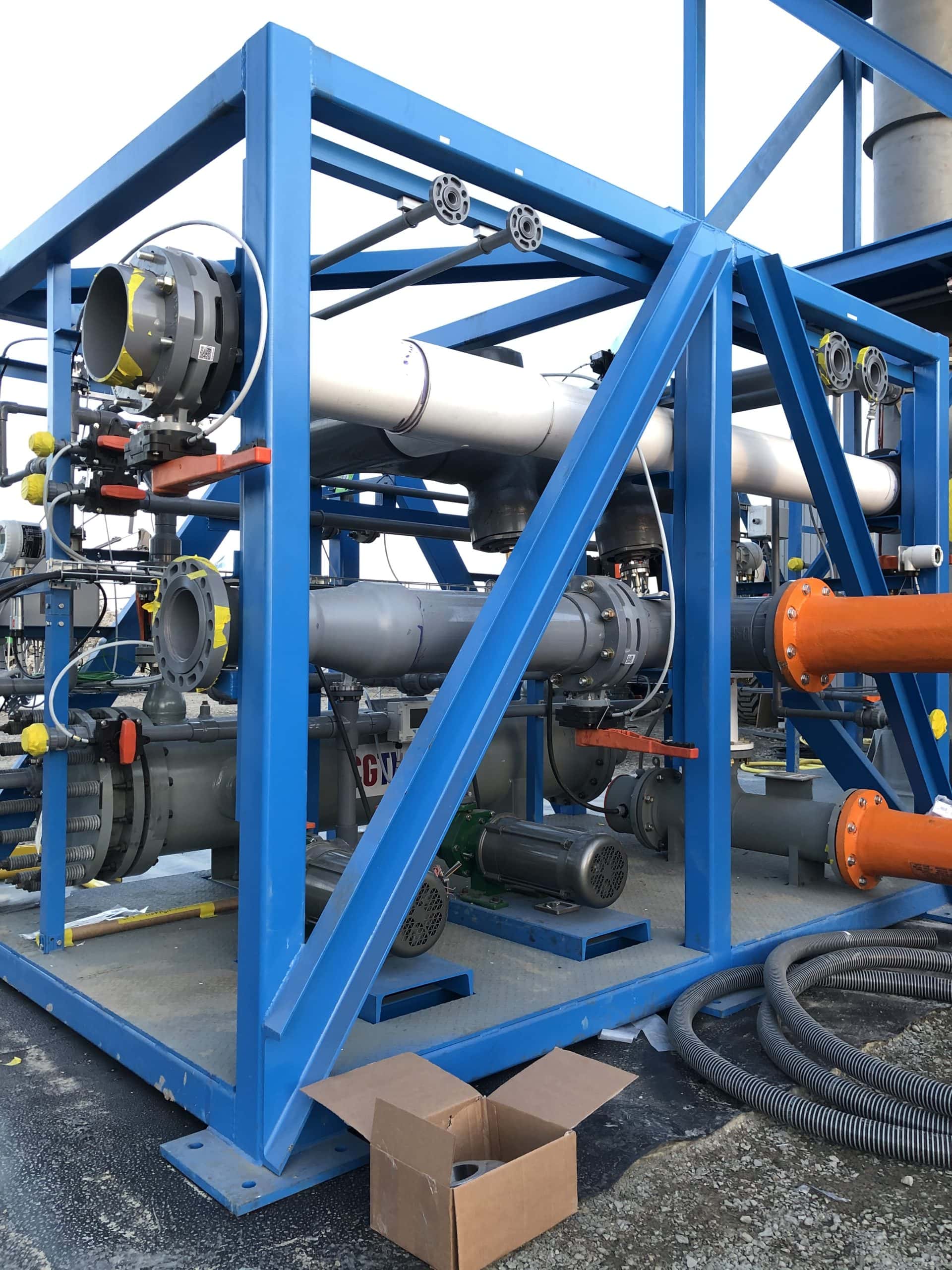
A project in Teckomatorp, Sweden, began with a request for a graphite heat exchanger and developed into a turnkey HCl condenser and scrubber system.
- Integrated design: Process modeling, material selection, equipment layouts, fabrication, instrumentation, controls, and field start-up assistance.
- Corrosion-resistant equipment: Impervite® graphite heat exchangers, scrubber modules, piping, pumps, and instrumentation selected for the process.
- Compact configuration: A modular assembly designed for standard shipping containers and variable feed conditions.
CG Thermal delivered the complete solution within six months—three weeks ahead of the quoted lead time.
Materials and Equipment for HCl Service
Material selection is part of process design. The full stream composition, concentration, temperature, pressure, and potential operating changes must be considered together.
CG Thermal’s capabilities include Impervite® graphite, Umax advanced ceramic, Impervite® Advanced graphite, fluoropolymer linings, FRP, nickel alloys, and corrosion-resistant vessels and components. Our team evaluates material compatibility and equipment suitability for the specific service.

HCl Process Applications
A useful starting point is the process requirement: recover HCl, produce a specified acid strength, condition a gas, or control a bath temperature. We work with customers to define that requirement and determine how the proposed system will connect with existing operations.
Graphite Purification
Natural graphite purification can involve chlorination roasting or fluidized bed processing. These operations can generate chloride-containing off-gases requiring absorption and scrubbing, including in graphite processing for battery materials.
CG Thermal evaluates gas composition, temperature, recovery objectives, and outlet requirements to define the appropriate off-gas treatment equipment. Material compatibility and integration with the upstream purification process are key design considerations.
Steel Pickling
Steel pickling baths require temperature control. Heat exchanger selection must consider bath chemistry, solids, maintenance needs, and the required thermal duty.
Contact Our Team
Share your HCl process challenge with CG Thermal. Whether you are evaluating recovery options, planning a new system, or selecting equipment for an existing operation, our team can help define the next steps.
Useful starting information includes stream composition, concentration, flow rate, operating temperature and pressure, and the desired product or treatment outcome. If those requirements are still being developed, tell us what you know about the process and what you need to accomplish.