


White Paper Preview
Material and design upgrades to graphite heat exchangers are often necessary when operating life falls short of expectations. Graphite heat exchangers have long been trusted in hydrochloric, sulfuric, and phosphoric acid applications due to their corrosion resistance and thermal conductivity. When properly applied, operating life can exceed 15–20 years.
However, graphite does not fail because it corrodes — it fails because it weakens over time.
Aging phenolic impregnation, vibration-induced microcracking, and cyclic operating stresses gradually reduce tube strength. Because graphite exhibits little to no deformation before fracture, tubes can appear normal one day and break the next — often without warning.
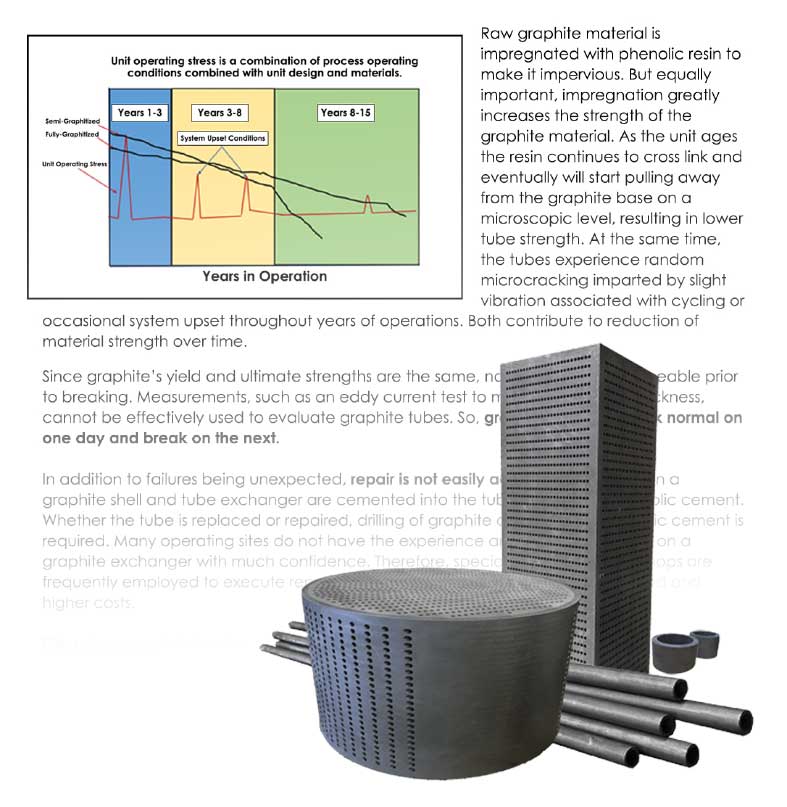
Download the Full White Paper
Access the full white paper detailing Material and Design Upgrades to Graphite Heat Exchangers, including graphite failure mechanisms, resin crosslinking effects, vibration considerations, and advanced material and sealing technologies that extend exchanger life.
A more effective approach starts with material and mechanical engineering. By improving base graphite quality, optimizing vibration control, and eliminating cemented tube designs through modern O-ring sealing systems, common graphite failure modes can be significantly reduced—extending service life while simplifying maintenance.
The full white paper expands on these material upgrades and advanced tube technologies, including ceramic and composite alternatives engineered for higher strength, improved erosion resistance, and enhanced thermal shock protection.